<< Intro – 2 - - Introduction – 3:6 - - Intro – 4 >>
March 11. 2020, "Turns the Excess Mortality Rate Table..!"
In the graphs below, you will find mortality data from 32 countries
The graphs below show that, starting in March 2020, significant fluctuations in mortality occurred simultaneously with the rollout/launch of new XG networks in a large number of countries. Subsequently—up to the present day [Dec. 2025]—entirely new mortality patterns have emerged in a very large proportion of the world’s countries, with a clear link [temporal correlation] to the expansion and modernization of countries’ XG infrastructure.
Analysis and understanding of this topic are based to a large extent on correlative patterns and known biological effects of mobile-like RF radiation; hence the research method [broad correlation analyses] we have chosen to use in our research on the short- and long-term health effects of XG systems.
March 11. 2020
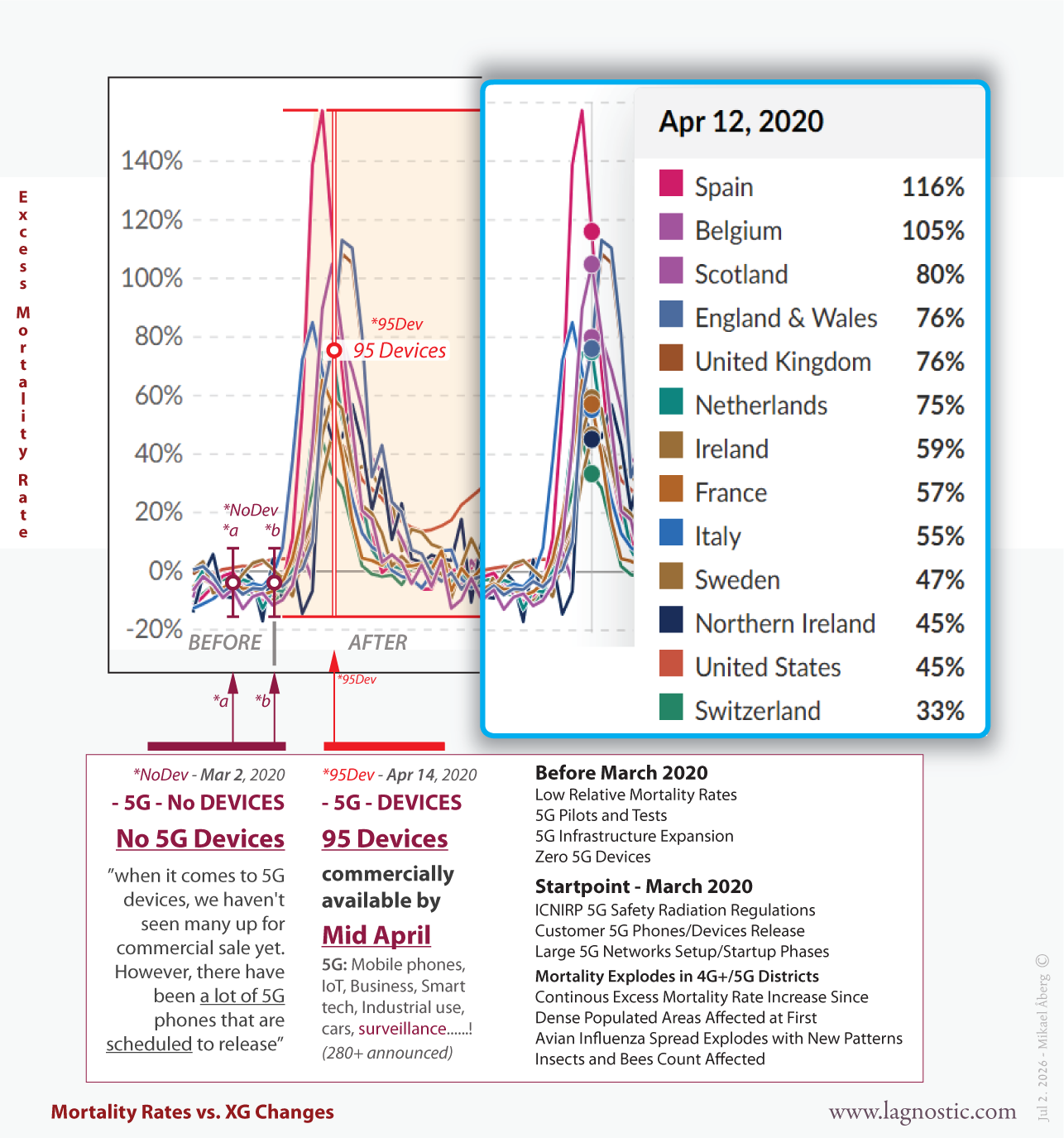
In conjunction with ICNIRP’s presentation of the international safety guidelines for radiofrequency radiation [March 11, 2020] regarding radio waves (RF)—the so-called 5G bands [RF bands, frequency bands]—the initial rollout of 5G mobile phones and other devices to consumers began. At the beginning of March [March 2, 2020], there were no 5G products on the commercial market, but 1.5 months later [April 14, 2020], there were 95 different types of products, such as 5G cell phones.
The number of customer-related products has been growing very rapidly since then. In addition, the 4G/5G network is being continuously upgraded with new base stations and antenna arrays, while existing RF infrastructure is being upgraded with modern hardware and software to increase bandwidth and coverage.
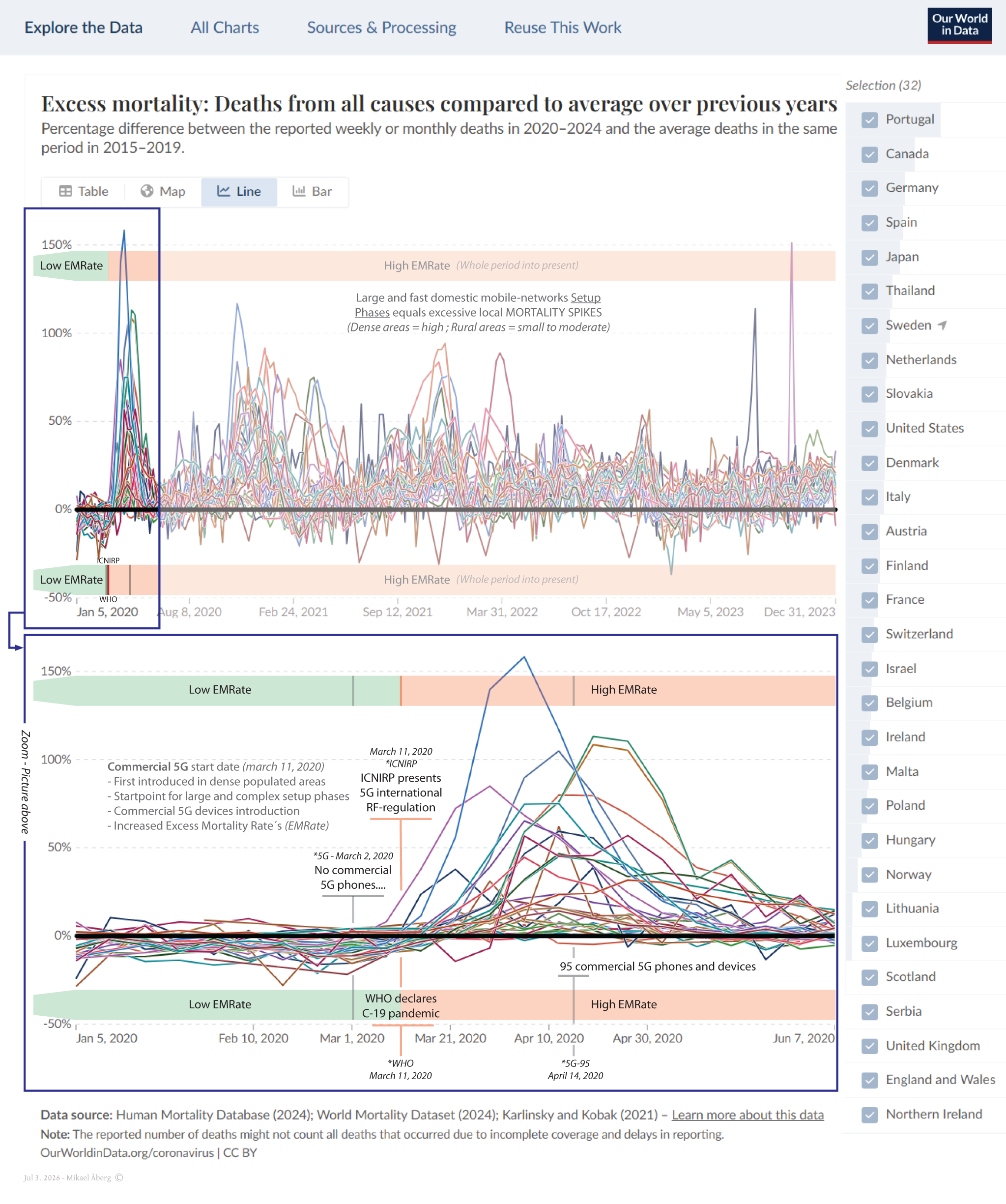
Below are two images showing graphical summaries that illustrate changes in mortality rates in some 30 countries with varying levels of 4G+/5G infrastructure deployment.
Rapid Changes in EM-Background Radiation Levels and mortality patterns
The period from March to April 2020—following ICNIRP’s international 5G recommendations and the resulting increase in the number of approved 5G products on the market—therefore marked the starting point for mobile network operators’ first major rollout phase of installed and updated 4G/5G infrastructure. During the same time period, the excess mortality rate (EMRate) was high or very high in several countries that were actively working to introduce the 5G standard into their cellular networks, initially focusing on large cities and frequently visited public gathering places.
Figure 1 [Year 2020-2024] shows a general breakdown of countries with varying levels of development [5G networks]; the lower portion of Figure 1 is a close-up of the period January–May 2020.
Figure 2 [March-April, 2020] shows a number of Western countries with rapidly expanding 5G infrastructure available to consumers during that period.
Enlarge Image: Click on the image – (All images, opens in new window)
1. ICNIRP - 5G Radiation Safety Regulations |
2. Introduction of 5G Cell Phones/Products |
 |
 |
EMRate curves for 32 different countries [Year 2020-2023] |
EMRate Curves for a Number of Early 5G Operators [Western Countries- January-June 2020] |
Changing Mortality Patterns
Both graphs show changes in mortality patterns in connection with ICNIRP’s presentation of international 5G guidelines [RF radiation, health] and the accompanying launch of 5G mobile phones/products; thereafter, the graphs show a sudden change that is reflected in the Excess Mortality Rate (EMRate) of the countries presented, with a sharp increase in mortality in several countries; a large number of countries have higher EMRate figures today [December 2025] despite high median figures [in 2020–2024].
The link between the rollout phases of 5G infrastructure and elevated EMRate can be clearly seen in the countries’ graph curves; the clarity observed during March–May 2020 is likely due to the fact that these rollout phases of 5G infrastructure were linked to densely populated or heavily visited areas, locations that influence a given country’s EMRate dynamics to a greater extent than the corresponding percentage change in mortality in rural areas and smaller towns.
Rural areas are affected when XG is launched
In general, no consideration whatsoever is given to the health and well-being of animals when constructing cell towers and other RF infrastructure, nor are there any exposure limits related to the health of animals and other life forms [domesticated or wild].
Since the start of the COVID-19 pandemic, there have been a large number of reports of illness and death among domesticated and wild animal species linked to 4G/5G expansion and modernization, such as a sharp increase and altered patterns of “bird flu,” “bee problems,” and changes in “insect fauna.” These life forms are particularly sensitive to RF microwaves—their wavelength composition [mix of RF bands] and highly interactive designs with pulsating, soliton-like [coherence, polarization] wave patterns of long-wavelength light [RF-EMF]—due to the species’ size, body design, and nervous system; more on this on other pages.
Excess Mortality Correlations in Practice! (Links open in new window [5])
It has been established that the COVID-19 (C-19, SARS-CoV-2) virus was present in Italy as early as September 2019 [3 months earlier than the generally accepted starting point], and that an early C-19 precursor was present as early as June 2019 (References). There were also strong indications of early C-19 transmission in China [October 2019], where a number of U.S. citizens developed COVID-like symptoms during the Military Olympics and recovered by January 2020 (References).
Italy, China, and the U.S. invested heavily in “5G deployment and testing” in connection with these early cases of COVID-19 (References).
A number of researchers have demonstrated the temporal link between telecommunications infrastructure expansion and COVID-19 outbreaks during the COVID-19 pandemic—at the local level (neighborhoods) as well as in cities and countries. (References). Furthermore, several researchers have shown that the spread of the COVID-19 pandemic cannot be satisfactorily explained based on how pandemics are normally expected to spread throughout society and around the world. (References).
The temporal and spatial correlation between different launch/update phases of the new 5G networks can be linked to significant variations in mortality patterns in the affected areas; the connection is very strong and has continued to be a recurring correlation theme throughout the entire study period up to the present, this has occurred in connection with both the expansion and upgrades of mobile networks.
The startup and configuration phases of installed 4G/5G infrastructure clearly show an elevated Excess Mortality Rate (EMRate), i.e., rising death rates. Subsequently, mortality rates drop relatively sharply once the systems are ready for use by customers or organizations; however, this does not represent a genuine recovery, as the median value remains well above normal levels in absolute terms, despite the temporary decline in the number of deaths.
>> Excess Mortality Rate — 4 >>